Culture, instruction, and partnership
This portfolio follows my learning across three courses. My self-assessment grounds the reflections; classroom and curriculum examples show how the ideas enter my practice. Where a current result or a specific artifact has not yet been documented, I mark its status plainly.
Course 1 · Cultural lenses → Course 2 · Responsive instruction → Course 3 · Learning partnerships
More than 20 years teaching visual art and five years coaching in ACPS have taught me to listen to what students and teachers reveal through making, conversation, and revision.
My work with Project Zero informs how I invite questions, notice student thinking, and make room for more than one interpretation.
In state standards work and district curriculum planning, I map standards, inquiry, artmaking, assessment, and reflection while keeping student voice central.
My graduate certificate in Learning Design and Technology has strengthened the way I plan learning experiences, examine evidence, and revise instruction. I see improving my teaching practice as an ongoing design cycle.
Characteristic #1 — Cultural Lenses
Culturally Responsive Teachers acknowledge, validate, and incorporate the cultural influences of all students, while reflecting on their own personal cultural lenses.
My self-assessment identified Indicators 1.1, 1.2, and 1.3 as relative strengths. Here I examine the experiences behind those ratings and how they shape decisions in the art room.
My Culture Tree
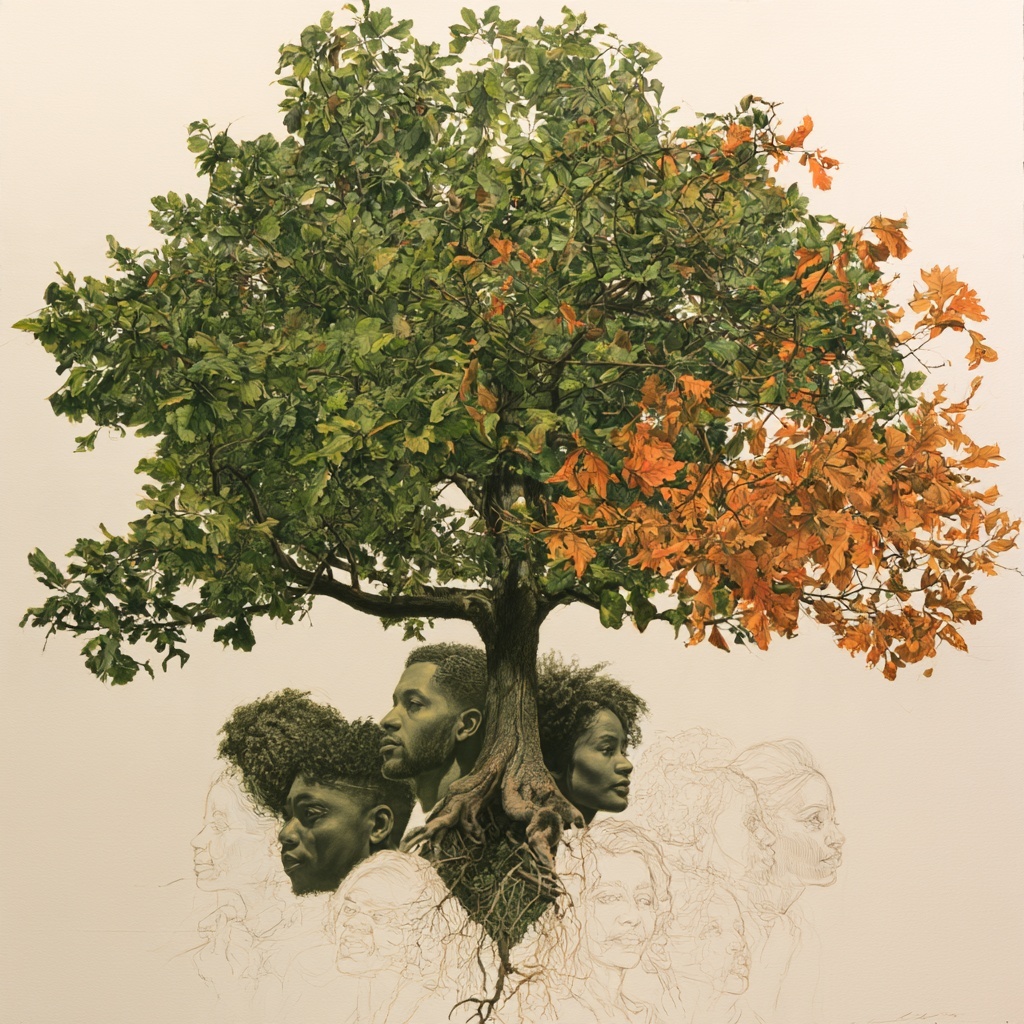
The image is my visual metaphor. The overlays name cultural layers; the people and roles in my life move through every layer.
I was born in Greensboro, North Carolina, and raised in the Virginia Beach–Chesapeake area. Meals and cooking, hip hop, jazz, gospel, books, art, family gatherings, and basketball are some of the visible ways culture has lived in my home and community. My life as an artist and writer gives me ways to make and share stories. Yet what is visible never explains the whole meaning of a practice.
My experiences in African American family and community life have been relational, full of fun, laughter, stories, food, music, and gathering. I learned to join experiences larger than myself and to talk through hard truths with others. Making eye contact and answering an elder was one small lesson about respect, not the center of this culture. My family was active in education, social justice, politics, and the arts, so sharing what we knew was part of how we cared for one another. As a mother, I made room for Jayden and Arianna to ask questions and find their voices. Teaching art has shown me that the unspoken rules for interacting with adults and peers vary across families and communities; I need to teach shared classroom expectations explicitly rather than assume everyone reads the same signals.
Family, faith, Black identity, dignity, justice, and opportunity shape how I understand the world. The elders in my Black community were active in the Civil Rights Movement. They taught us that excellence was the standard and that we should push beyond the limits others might place on us. Achievement and sharing knowledge mattered for both personal growth and community improvement. Food has a history: I think about what was made available to Black communities, how people made nourishment and tradition from those conditions, and why a meal can carry care and memory beyond what is on the plate. Choosing hip hop, jazz, and gospel for my family has been deliberate too. In a Charlottesville environment I have experienced as racially charged and at times negative toward Black people, music helped us affirm who we are and hold onto our own sources of power. HBCU culture was part of my family's world. I attended an HBCU my freshman year and transferred to UVA; only later did I fully understand how intentionally the HBCU environment nurtured Black students. Its foundational seminar experiences offered something I did not find in the same way at UVA. UVA also taught me to figure things out with my own wits. I carry value from both experiences.
High achievement runs through my family, and I have sometimes been seen as its lowest achiever. Living with that comparison gave me empathy for people who follow what is in their hearts, even when their path does not fit someone else's measure of success. Motherhood, marriage, divorce, and major health experiences have deepened my understanding of strength, vulnerability, and care. My faith calls me to meet people where they are. Feeling unaccepted in parts of the art world has also helped me make room for people who see and express the world differently. I can hold high expectations without making achievement, confidence, or readiness look only one way.
Reflection: communication style
I grew up in a family where conversation, laughter, and telling the truth about difficult things were ways of belonging. Relatives active in education, social justice, politics, and the arts taught me that sharing knowledge matters for both self-understanding and community improvement. I carried that relational approach into teaching and into the home I made for Jayden and Arianna. In my classroom, I am visual and direct, but I also explain the “why,” demonstrate, invite questions, and make room for joy.
After 20 years of teaching art, I have learned that the art room can be a safe space to practice these skills. As students make things together, I notice how they interact with adults and one another, and how those interactions may be shaped by family expectations, racial and ethnic cultures, LGBTQI+ communities, and different European cultural traditions. I cannot assume that everyone within a group communicates alike. My role is to coach students in listening, expressing themselves, and working together because their differences matter and can enrich the room.
It surprised me to encounter people and settings where talking through hard truths or sharing knowledge openly was less welcome or happened differently. I have come to appreciate both why those practices are important to me and why others may need a different pace or way into them. A student may need processing time or communicate more comfortably through an image, writing, a small group, or a private conversation. Differentiation means meeting neurodivergent students and students with disabilities where they are, too. My faith teaches me patience and care; my experiences of feeling unaccepted in parts of the art world remind me to make room for people who see or express the world differently.
Reflection: learning design
My HBCU and UVA experiences taught me different things about support and independence. I want students to be nurtured and known, with the kind of intentional foundation I came to appreciate, while also developing the resourcefulness that became foundational for me at UVA. My family's Civil Rights generation taught me to expect excellence and to push beyond limits imposed by others. I design art learning with demonstrations, routines, and rigorous goals alongside choice, identity, storytelling, experimentation, and more than one way to show understanding. My own experience of being measured against high-achieving relatives reminds me to ask what a student is working toward, rather than equating one kind of accomplishment with worth.
My family taught me that art, education, and conversation can serve a purpose larger than the individual. I want students to have opportunities to share what they know, ask hard questions, learn from one another, and use art to improve how they understand themselves and their communities. My own relationship to food and music reminds me that a visible choice can carry a history, a way of caring, or a response to the surrounding culture. I invite students to explain the meaning of their choices when they wish to, while offering private, visual, written, or slower routes to reflection. My health experiences reinforce that capacity is not always visible and can change from day to day. Students should have clear expectations and access to the supports that let them meet those expectations.
Gathering table analogy
The table I grew up around was a place for food, laughter, stories, and sometimes difficult truths. People shared what they knew about education, art, politics, and justice because our lives were connected to a larger community. In the home I made for Jayden and Arianna, I wanted that sense of connection alongside room for their own questions and voices. In my classroom, the shared table is an invitation: students can contribute, listen, and learn together, with different ways and amounts of time to enter the conversation.
Course framework: tree and iceberg views of culture
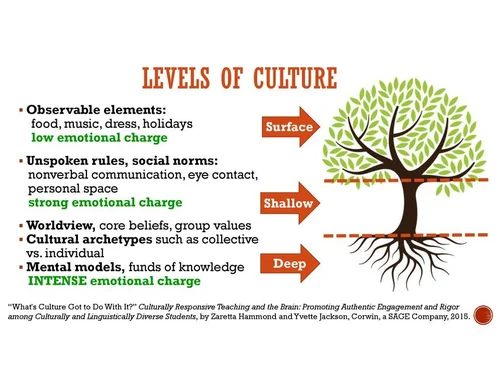
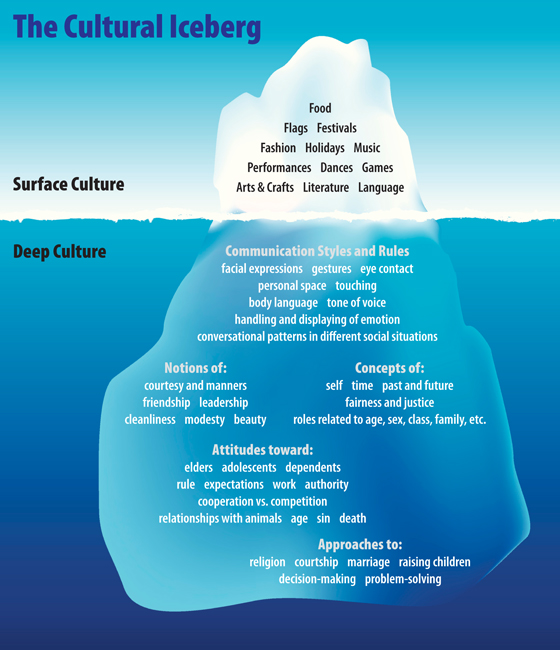
Reference images supplied with the Culture Tree materials. The iceberg is especially useful here: food and music are visible, while their history, purpose, and meaning extend beneath the surface.
Reflecting on Personal Cultural Influences
Reflection protocol — a recurring classroom situation
Situation. A recurring situation I want to examine is what happens when I give a conversational reminder or broad direction during studio work—something like “Are we ready to clean up?” or “You should be moving into the next step”—and a student does not respond in the way I expected.
My first interpretation. My immediate reaction can be that the student was not listening, was choosing not to follow the direction, or was not taking the class expectation seriously.
What my own lens may be contributing. I value clear routines, shared responsibility, and follow-through. Because I often use relationship and conversational tone rather than a highly formal command style, I may assume that the directive is obvious. Hammond’s example of “Would you like to take your seat?” is a useful reminder that what sounds like a directive inside one cultural frame can sound like an actual choice inside another.
Re-evaluating the assumption. Before assigning motive, I can ask whether the direction was explicit, whether the student needed visual or individual clarification, whether language or processing time mattered, and whether I am interpreting a different communication style as resistance. The behavior may still need to change, but my explanation for the behavior does not have to begin with deficit thinking.
Shift in practice. I can pair relational language with clear, concrete directions; use visible step-by-step routines; give transition warnings; check for understanding without embarrassment; and offer multiple ways to respond. I can also notice my own triggers—especially when shared routines or material-care expectations are not followed—and pause long enough to separate impact from assumed intent.
Personal cultural assets I bring
I bring a strong belief in creative possibility, high expectations, persistence, visual communication, relationship-building, and reflective practice. The elders in my Black community, active in the Civil Rights Movement, taught us to pursue excellence beyond the limits others might set for us. Growing up among family members active in education, social justice, politics, and the arts also taught me the joy of gathering and the value of talking through hard truths. Sharing knowledge was a way to improve ourselves and serve a community larger than any one person. My family's food and music choices taught me that care and cultural affirmation can be deliberate responses to a wider environment.
I know how it feels to be seen as the lowest achiever among people who accomplish a great deal. That experience helps me question whether I am measuring a student against a narrow idea of success and gives me empathy for someone following what is in their heart. In 20 years of teaching art, I have learned to notice how students approach adults and peers without assigning meaning too quickly. It surprised me to find that open conversation is not comfortable or customary in every setting. Family expectations, racial and ethnic cultures, LGBTQI+ communities, European cultural traditions, disability, and neurodivergence may shape communication, but no label tells me how an individual student communicates. My faith and my own experience of exclusion in the art world push me to ask, listen, and adjust the pace.
Learning About and Affirming Student Identities
Intentional method
I use the opening interactive sketchbook cover/identity design as an intentional way to learn about students. Students design their names in block or bubble lettering and fill the design with interests, symbols, images, colors, and references that matter to them. Because this happens visually, students can communicate pieces of identity that may not surface in a traditional written “get to know you” survey. I continue learning through sketchbook prompts, informal studio conversations, observation of student choices, and artist reflections. My work with Project Zero encourages me to attend to the thinking behind the image: I can ask what a student notices, wonders, or intends, and document their words rather than assume I already understand the symbol.
What I learned
The most important takeaway is that students do not experience identity as a single category. Their visual choices reveal overlapping interests, communities, aesthetics, relationships, hobbies, media, places, traditions, and personal experiences. I know from my own life that a reference to food or music may hold family memory, historical knowledge, care, or a choice to affirm identity. I cannot infer all of that from the image alone. I also see that students differ in how much of themselves they want to disclose publicly. Culturally responsive practice should create invitations rather than demand personal disclosure.
The method gives me a starting point for noticing what visual languages students already use and what knowledge they bring into the room. I can follow up privately or through an artist reflection and ask what a student wants me to know. It helps me move from “What do I want them to draw?” toward “How can the art skill become a tool for students to communicate something they care about?”
Instructional shift
I carried that information into the Expressive Hands project. Rather than having every student solve the same visual problem with the same imagery, students use hands, patterns, objects, color, and background imagery to communicate something about themselves while still working toward shared visual-art goals. The shift is from teacher-selected subject matter to a structured choice-based task in which personal and cultural knowledge becomes a legitimate source for making art.
I also build in varied entry points: demonstration, visual exemplars, peer discussion, independent work, and reflection. This preserves rigor while giving students more than one route into the task.
Student work evidence
Inclusive Curriculum + Resource Audit
Area selected for audit
I chose to audit the artists, visual exemplars, and instructional references that students encounter across my middle-school art curriculum. In visual art, the people we present as artists, designers, makers, and authorities communicate who belongs in the discipline just as strongly as the written curriculum does. When I plan and map curriculum for the district, I carry this question through the sequence as a whole—where inquiry begins, whose work students encounter, how they make meaning, what counts as evidence of learning, and how the goal can reveal inequitable access.
Questions I used
- Who is consistently presented as an expert or model?
- Are diverse artists core to the lesson, or only supplemental?
- Do students see living and contemporary artists as well as historical artists?
- Do the examples represent varied cultures, identities, media traditions, and ways of making?
- Do students have opportunities to contribute artists and visual references from their own worlds?
- When a resource includes food, music, or another visible cultural form, do we also examine its history, purpose, and meaning rather than treating it as a decorative symbol?
- Are students represented only through “heritage” topics, or throughout ordinary instruction in drawing, design, photography, sculpture, clay, and media arts?
What the audit showed
A strength in my curriculum is that student voice and choice are already embedded in the artmaking process. Students work with identity, communication, design, social/cultural themes, and multiple media rather than simply reproducing a teacher example.
The growth area is making representation systematic rather than allowing it to depend on whichever artist or image happens to fit a lesson. My own experience of feeling unaccepted in parts of the art world makes me especially attentive to who is presented as an artist and whose way of seeing is valued. A culturally responsive curriculum should not make diverse artists feel like a special add-on; students should regularly encounter many kinds of people as innovators, experts, and working artists.
Changes I am making
I am building artist/reference sets by concept and medium rather than relying on a single “master artist” model. For example, a lesson on line, portraiture, identity, form, pattern, photography, or sculpture can include several artists whose work approaches the same concept differently. I can also invite students to suggest artists and visual culture that connect to the concept, then vet those references for instructional value.
I am also paying closer attention to the physical and digital learning environment: whose work appears on slides, posters, example boards, sketchbook references, and demonstration materials. The goal is for representation to be woven through the everyday curriculum.
Partner feedback
Characteristic #2 — Culturally Responsive Instruction
Culturally Responsive Teachers teach to and through culture as they plan curriculum and instruction that is differentiated, rigorous, and relevant.
This course moves from reflection to instructional decisions: who benefits, how students demonstrate learning, and how students learn to communicate across difference. My graduate study in Learning Design and Technology reinforced the habit of designing a learning experience, examining what it makes possible for students, and revising the structure when it does not yet serve them well.
How do I help students “care about it” and “identify with it”?
I prepare instruction so students can see a connection between the learning and something that already matters to them. In art, that means building in meaningful choices, using artists and examples that reflect a wide range of cultures and identities, and giving students opportunities to connect projects to their own interests, experiences, families, communities, and ways of expressing themselves. I also learn what students are interested in through conversation, sketchbook prompts, observation, and the choices they make in their work, and then use that information when planning future lessons.
I also think students are more likely to care about learning when they understand the purpose behind it. I try to make the “why” visible—why we are practicing a skill, why an artist or idea matters, and how the learning can connect to something beyond the assignment itself. Project Zero’s attention to visible thinking enters this conversation for me: questions, sketches, dialogue, and reflection can show how an idea develops, rather than leaving only the finished object to speak for the learner. My curriculum framework work helps me plan that path from inquiry to making to reflection, with multiple entry points and a shared rigorous goal.
Ultimately, I want students to feel that the curriculum is not simply something being delivered to them. I want them to recognize themselves within it and to feel that their ideas, identities, and experiences are legitimate sources for learning and creating. When students can identify with the work and have some ownership in it, they are more willing to take risks, persist through challenges, and invest in the learning.
How My Curriculum Maps Support Culturally Responsive Teaching
These Grade 6–8 maps show how I plan culturally responsive learning across a progression, not just within one lesson. Each connects VDOE visual arts standards and the ACPS Framework for Quality Learning to essential questions, understanding–knowledge–doing goals, assessment evidence, visible thinking strategies, and responsive access or extension. The maps build from exploration, to purposeful making, to investigation and personal voice.
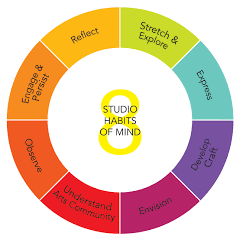
Where art thinking and CRE meet
The Studio Habits give me language for the thinking students practice as artists: observing, envisioning, expressing, persisting, reflecting, and understanding art worlds. I include those habits and visible thinking strategies in the curriculum maps so the learning process can be noticed and discussed, not judged only by a finished product.
Zaretta Hammond's culturally responsive framework sharpens the next question: Am I drawing on students' cultural knowledge as a resource for rigorous thinking, and am I giving them a supported path toward greater independence? Together, these lenses help me keep the art standard ambitious while making students' thinking, identities, and growth visible.
Framework references: Project Zero's Eight Habits of Mind and Hammond's Ready for Rigor framework. Diagram supplied for this portfolio.
A nine-week entry into visual language, observation, studio community, and cultural connections.
Download Grade 6 map (.docx)A semester of transferring visual skills across media, testing choices, and revising with feedback.
Download Grade 7 map (.docx)A year-long inquiry into identity, intention, material choices, and an increasingly independent artistic voice.
Download Grade 8 map (.docx)My CRE lens appears in the design choices: an invitational studio environment, multiple entry points, student-centered inquiry, and ways to adapt access or extend challenge while keeping the learning goal meaningful. The maps also give me a structure for asking whose perspectives are present and whose ways of demonstrating understanding are supported. My graduate work in Learning Design and Technology informs this cycle of planning, examining evidence, and improving practice. These documents demonstrate my planning. Student work, feedback, and disaggregated results will show how the design affects learners.
Equity Audit
Problem of practice
I want to examine whether my consistent studio routines and assessment structures provide equitable access to success for all students, especially during independent studio work, timed observational drawing, project completion, reflection, and revision. Predictable routines are a strength, but a routine can still advantage students who are already comfortable with a particular pace, amount of independence, or mode of demonstrating learning.
Measures
| Category | Evidence to examine | Question |
|---|---|---|
| Academic achievement | Project rubric scores / standards evidence from one major project | Growth by criterion, not just overall grade |
| Student engagement | Task initiation, work completion, revision, sketchbook participation | Who starts independently? Who stalls? Who revises? |
| Academic mindset | Student self-assessment / confidence reflection | Perceived competence, willingness to take risk, ownership |
| Relational data | Conference notes / student feedback | Who seeks help? Who responds better privately, visually, or in peer structures? |
How this connects to CRE-guided SMART goals. The earlier goal shows that I was already building measurable outcomes into art instruction. This is also an idea I carry into the curriculum frameworks I plan and map for the district: goals should be clear and measurable, while the path to them makes room for different learners. Culturally responsive education deepens the question: Which students are included in a percentage, whose thinking is visible in the evidence, and who needs a different access point or way to demonstrate the same standard? I can set a target and timeframe while examining results by group, listening to student experience, and adjusting instruction. The historical 85% target explains the development of my thinking; it is not evidence that the target was met.
Findings and focus
2026–27 findings: TBD. I will compare at least two assessment points, disaggregate relevant patterns, and check what the numbers suggest against student voice and classroom observations. That analysis will identify who is benefiting from current routines, who is not yet benefiting, and the specific focus for an instructional adjustment.
Problem of practice / root cause question
A question within my control is: Are students receiving enough varied access points, scaffolds, and assessment modes to enter the same rigorous learning goal through their strengths? I want to distinguish between a student not understanding the art concept and a student being blocked by the way I have structured the task, pacing, directions, or evidence of learning. This includes checking whether neurodivergent students and students with disabilities can use the supports they need, without assuming the same approach fits every student.
CRE-guided SMART goal statement
I will use disaggregated project, engagement, and student-reflection data to identify which students are not yet benefiting from current studio routines and implement at least two differentiated supports.
So that students will show increased task initiation, completion/revision, and growth on the targeted art standard without lowering the cognitive demand of the task.
We will measure the goal by comparing the same indicators across the next instructional cycle and collecting a brief student reflection on which supports helped them learn.
I will collaborate with my PLC, an instructional coach, or another reflective partner to review the data and challenge my interpretation of the patterns.
Instructional responses to examine
- Visual process checklists and exemplars without requiring one visual outcome.
- Choice of entry point or sequence when the learning goal allows it.
- Short teacher conferences or strategic flexible grouping.
- Multiple modes for reflection and evidence of understanding.
- More explicit feedback/revision cycles so assessment leads to growth rather than simply recording performance.
Culturally Responsive Classroom Assessment Inventory
Engagement
The assessment engages students because the visual problem is structured but the content is personal. Students work toward common art goals while choosing imagery, patterns, objects, color, and compositional decisions that communicate something about themselves. This makes the assessment more than a drawing exercise; students have a reason to make decisions and explain them.
Rigor
Students are not only asked to demonstrate technical skill. They must plan composition, make intentional visual choices, solve spatial and design problems, revise work, and connect formal elements to meaning. Higher-order thinking appears when students decide which visual strategies best communicate an idea rather than simply copying a teacher example.
Students construct meaning by determining what the hands and surrounding imagery will represent, how the visual elements relate to one another, and what they want a viewer to understand from the work. I hold a strong standard for thought, craft, and revision while leaving room for different subjects and personal ambitions. Excellence can appear in a student's courageous idea and growth, not only in work that resembles a prescribed model.
Cultural identity
The assessment allows culture to enter through student-selected visual content rather than requiring every student to respond to one teacher-selected cultural reference. Students can draw from interests, family or community references, symbols, aesthetics, traditions, media, places, and experiences that are meaningful to them.
This helps bridge social/cultural identity and academic identity because the student’s own visual knowledge becomes material for practicing composition, line, shape, color, value, pattern, craftsmanship, and visual communication. Students may also use the work to share knowledge or raise a question that matters to their community; they choose how much to explain and whether to do so publicly or privately.
Relationships
Collaboration can be integrated through peer feedback, table conversation, gallery walks, critique stems, and informal idea-sharing. I coach students to ask before interpreting, listen to an artist's intention, and respond with care when a peer's cultural reference or way of expressing an idea differs from their own. The goal is for peers to help one another clarify intention and notice how effectively the visual choices communicate.
Vulnerability
Identity-centered art can involve appropriate risk. I support that risk by making disclosure invitational rather than required, modeling multiple possible responses, using formative feedback before final evaluation, and emphasizing growth and decision-making rather than “talent.” Students can choose how personal their imagery becomes while still meeting the same learning goals.
Assets
Students can draw on many assets: visual storytelling, pattern and design, drawing, color sense, personal knowledge, cultural references, humor, symbolism, persistence, collaboration, and reflection. The assessment gives students more than one way to demonstrate strength while keeping the art standards constant.
Applying Social Justice Standards
Selected standard
| Domain | Diversity |
|---|---|
| Standard | 8 |
| Grade level | 6–8 |
| Grade-level outcome | DI.6-8.8: I am curious and want to know more about other people’s histories and lived experiences, and I ask questions respectfully and listen carefully and non-judgmentally. |
Process / actions in my classroom
Across 20 years of teaching art, I have seen the art room offer a safe place to practice interacting across differences. I bring my family's example of joyful gathering, honest conversation, and sharing knowledge for community improvement, while recognizing that students may need different ways and amounts of time to join a discussion. My job is to coach those interactions because the differences are part of our shared learning. Racial or ethnic identity, LGBTQI+ identity, European cultural background, disability, or neurodivergence never defines an individual student's behavior. I can intentionally build this outcome into critique, artist study, gallery walks, collaborative discussion, and student reflection.
- Establish critique agreements that value curiosity, respectful language, active listening, and interpretation before judgment.
- Use stems such as “I notice…,” “I wonder…,” “What influenced…?” and “Can you tell me more about…?” so students have language for respectful inquiry.
- Present artists and visual traditions through multiple perspectives rather than a single cultural narrative.
- Give students opportunities to explain their own choices through artist statements or brief reflection without requiring them to disclose private information.
- Ask students to respond to the meaning and intention of a peer’s work before evaluating whether it matches their own taste.
- Interrupt stereotypes or biased comments in the moment and use them as opportunities to clarify language, impact, and classroom values.
How I will know it is leading to the desired outcome
I will look for changes in the quality of student questions and critique language over time. Evidence can include critique sheets, reflection responses, teacher observation notes, student artist statements, and short exit tickets asking students to name something they learned from a perspective different from their own.
I will know the process is working when students move beyond statements of personal taste (“I like it / I don’t like it”) toward respectful curiosity, careful listening, specific interpretation, and the ability to engage with a peer’s idea without reducing that person to a stereotype or category.
Characteristic #3 — Learning Partnerships
Culturally responsive teachers build positive learning partnerships with students, families, and communities.
My self-assessment named community partnerships as an area for deeper attention. The sections below connect my current classroom practice to a concrete plan for gathering evidence and extending those relationships.
Students as Learning Partners
Point of connection
Art offers me many small opportunities to know students through what they choose to make, the images they return to, and the ways they respond to a visual problem. I can use sketchbook conversations and brief studio conferences to learn what matters to a student while sharing my own process as a working artist with appropriate vulnerability. Having felt unaccepted in parts of the art world, I want the art room to make space for students who see the world differently. I can ask how each student prefers to share ideas or receive feedback, then adjust without lowering the art goal. That common ground can support trust without assuming that a student's identity or interests are fixed.
Trust and academic growth
Relationship is visible in how I respond to risk. I can affirm a student's idea, ask what they want the work to communicate, give precise feedback on the art goal, and invite revision. I come from a family where excellence was expected as a response to barriers placed before Black people. I carry that belief in students' possibilities, along with empathy from knowing how it feels to be compared with high-achieving relatives. High expectations become credible when students see that I will help them reach a rigorous goal and honor the direction their own hearts and ideas take. I want to track whether students who initially hesitate begin to ask questions, attempt alternatives, and explain their decisions with more confidence.
Asset-Based Family Collaboration
Starting point
I want families to encounter art class through the student's thinking and strengths, not only when a concern needs attention. A brief invitation to share a student's creative interests, visual traditions, making practices, or preferred ways to receive feedback could help me learn what I might otherwise miss. Participation should be voluntary and available through accessible, translated communication where needed.
Next cycle
For a selected project, I can share the learning goal and a few examples of how students may demonstrate it. I can invite a family to describe a strength they notice and ask the student which goal they want to pursue. I would then summarize the shared goal and follow up with a work sample or student reflection. The family remains a partner in interpreting growth, not a source of material for a lesson without consent.
Community Wisdom in the Art Room
Reflection from my self-assessment
I identified community partnership as a place to deepen my practice. I had begun considering connections such as local media, including NBC29 and CBS19, but I also wanted to become more intentional about inviting families and community members into learning. The useful question is what expertise students can encounter and how that exchange changes what they learn or make.
Proposed art and community connection
I can invite a local artist, maker, designer, photographer, or family member to discuss how visual communication works in their practice. Students would prepare respectful questions, compare the visitor's choices with examples they studied, and apply one idea in their own work. A second route is a local visual-storytelling project in which students examine who is represented in community images and create a response for an authentic audience.
From seeing to responding to partnering
Course 1: Examine my lens and make room for students' identities in the visual arts curriculum. Course 2: Use that knowledge to design rigorous choices, assess learning in more than one way, and examine who benefits from my routines. Course 3: Carry the work into reciprocal relationships with students, families, and the wider community.
My work with Project Zero and with curriculum frameworks gives me a way to connect the three courses: make student thinking visible, build coherent structures for learning, and revise those structures in response to what students show and say. Earlier yearly-goal planning already aimed for measurable art learning. A CRE-guided SMART goal adds attention to who benefits, how students can show understanding, and what I change when the evidence reveals a gap. My next evidence cycle is to invite student voice, review an assessment pattern, adjust instruction, and ask students and families what the change made possible. I can then describe impact with work samples and feedback rather than relying on intention alone.
Project Zero framework reference: Visible Thinking, Harvard Graduate School of Education. This informs my reflection; classroom examples and results still need my own evidence.
End-of-Course Feedback Surveys
Open Course #1 survey
Open Course #2 survey